

Why We're All Wrong About Everything All The Time
How disagreement, diversity of thought and honest debate help us find more useful answers

This article uses framework terminology from The 7 Skills to impress™. Any definition or tool shown in bold can be looked up in the Glossary.
Pick any topic. Climate policy. Whether pineapple belongs on pizza. The best way to raise children. Now watch what happens when two people who disagree try to talk about it. Within minutes, both sides are working harder to win than to understand. Both are convinced the other is wrong. Both walk away with their original view slightly more hardened than before.
Here’s the thing: both sides can usually spot the weakness in the other person’s argument. The harder bit is spotting the weakness in their own.
I want to make an argument that might initially seem defeatist but is actually rather liberating. There is a compelling case, rooted in evolutionary biology, that humanity was never designed to come up with the right answers to things. We are built to come up with many answers, wildly varied, frequently contradictory, and often stubborn to the point of infuriating. This is not a flaw. It is the point.
Think about our early ancestors, several million years ago, when many still relied partly on trees for safety. Over time, different groups adapted in different ways. Some moved further towards the dangers and opportunities of open ground. Others stayed closer to the relative safety of the trees.
Those who stayed near the trees had good reasons: safety, familiarity, height, cover. Those who moved onto the ground had good reasons too: more food, more space, new opportunities. Neither position was simply right. Neither was simply wrong. Each was a partial reading of the world from a different position.
Some ground-living groups died. Some thrived. Some tree-dependent groups survived for long periods too. What mattered was not whether one view was true forever. What mattered was whether it was useful in the conditions of the moment.
History records the outcome as inevitable, the movers as visionaries. But that is history tidying up what was, at the time, a genuine and reasonable disagreement. The point was never who was right. The point was that the species tried both options simultaneously, and one turned out to be more useful at that particular moment.
Nature does not want consensus. Nature wants variety. When a population holds a wide range of views and acts on them with varying degrees of conviction, something useful will emerge, not because one person had the right answer, but because the spread of attempts guaranteed that at least one of them would work. Disagreement is not a bug in the human system. It is a survival strategy.
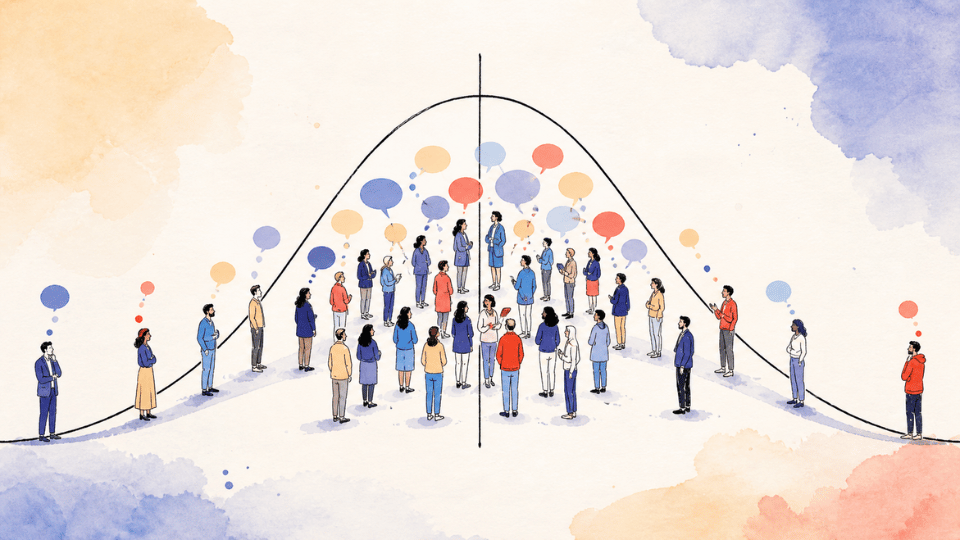
This is what I call Newton's Law of Debate, borrowing Newton's name deliberately, not because the physics maps precisely, but because the image of equal and opposite forces captures something true about how arguments work. The principle is mine, not Newton's, and it is this: for any strongly held viewpoint, there is likely to be a valid opposing perspective that also deserves consideration. It does not say both views are equally accurate. It says both views exist for a reason, and that the conversation between them is where something useful tends to develop.
When you bring together a genuinely diverse range of views on any topic, something interesting happens. The distribution of those views forms a shape that statisticians would recognise immediately: a normal distribution, as shown in the header image.
The extremes are well represented, and the middle is where most people sit. If you take the average, the mean of that distribution, you find yourself very close to what James Surowiecki calls the Wisdom of Crowds.
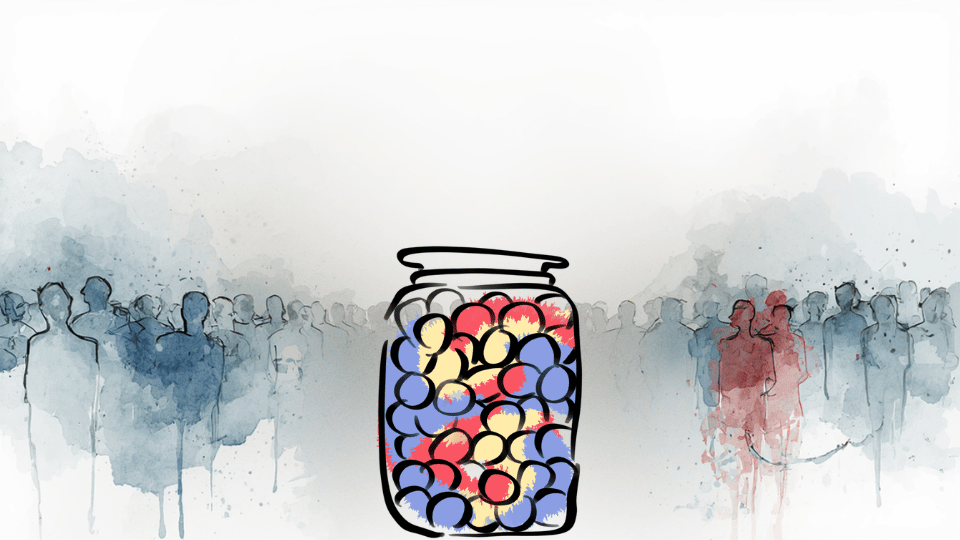
In his book of the same name, Surowiecki describes the observation made by Francis Galton at a 1907 livestock fair, where around 800 people were invited to guess the weight of an ox. Nobody got it exactly right. But the median of all the guesses came within a few pounds of the actual weight, closer than almost any individual estimate.
He makes the same point with experiments where people guess the number of marbles or sweets in a jar. Individual guesses vary wildly, but the more independent guesses you add, the closer the average tends to get to the real number.
The collective view, taken across a wide and varied population, is reliably more accurate than almost any single individual view within that population.
This is not the “right” answer. It is the most useful answer available at that moment, given what is known.
Surowiecki is careful to identify the conditions under which this works. The crowd must be diverse. The guesses must be independent, people forming their views without being influenced by what others around them think.
When those conditions are met, the mechanism is remarkably robust. When they break down, when people start copying each other, or when social pressure nudges everyone toward the same position, the wisdom evaporates. You no longer have a crowd thinking. You have a crowd performing.
This distinction matters, because it explains exactly what goes wrong when we interfere with the distribution.
We do it in two ways, and both of them reduce the usefulness of the outcome.
The first distortion is suppression. We decide that the views at the extremes are too dangerous, too offensive, too irresponsible to be given space. This feels reasonable; extreme views are, almost by definition, the furthest from the mean and therefore the furthest from the useful solution.
But removing one extreme does not neutralise it. It shifts the mean in the opposite direction. Silence the far right of any debate, and the average drifts left. Silence the far left, and it drifts right. You no longer have the wisdom of the crowd. You have the wisdom of the crowd with one hand tied behind its back.
A fair challenge here: what about views that are not just extreme but factually wrong? The problem is that question contains its own answer. Who decides what is factually wrong?
The moment you concede that authority to anyone, a government, a platform, a social consensus, you have handed them the power this principle is designed to resist. In practice, the views most commonly labelled as too wrong to be heard are not the ones that would corrupt the average. They are the ones that are politically inconvenient, socially uncomfortable, or outside the approved range.
And the extremes, in any case, tend to cancel each other out. The wildly wrong view at one end has a mirror-image wildly wrong view at the other. The mean sits somewhere between them, and that is where usefulness lives.
There is a threshold worth drawing, but in free societies it sits in law rather than taste: incitement to violence, to riot, to crime, for example. That line exists, and it should. Everything else is a conversation.
The second distortion is moral ranking. We assign intellectual or ethical value to certain positions, placing them above others not because of their accuracy but because of their social acceptability.
This distorts the picture in a different way. People whose views sit closer to the approved position speak more loudly and more often. People whose views sit outside it stay quiet, not because they do not hold those views, but because they do not want the label that comes with expressing them.
The distribution shrinks. The range narrows. The average becomes less useful, because it no longer reflects what people actually think. It reflects what people are willing to say.
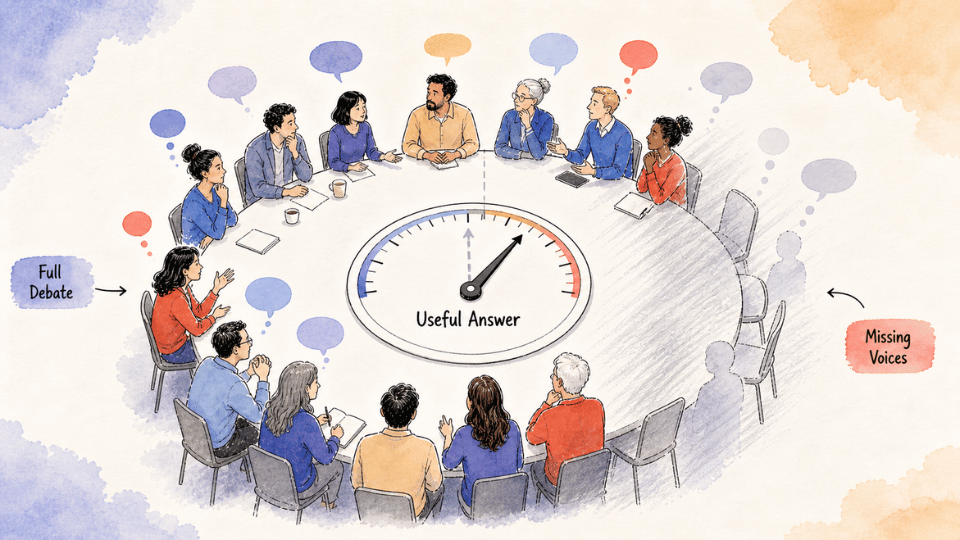
There is a phrase that tells you, reliably, that one or both of these distortions is already at work: "everyone agrees." Whenever I hear those words, I have learned to look more carefully at what is being described. Real universal agreement on anything of substance is essentially impossible.
When you encounter the appearance of it, what you are almost certainly looking at is a debate that has been managed, whether by suppressing extreme voices or by making certain positions socially costly to hold. The consensus is not genuine. It is the appearance of consensus, and it is a much weaker thing.
Both of these distortions are well-intentioned. Both make the collective intelligence less reliable.
The practical lesson is this. The purpose of debate has never been to win. It has never been to prove someone wrong or to protect the group from dangerous thinking. The purpose of debate is to add your genuine, honestly held view to the distribution, so that the average has as much information in it as possible. The more views, the wider the range, the more independently they are held, the more useful the outcome.
People who understand this approach debate differently. They are curious rather than combative. They listen not to find the flaw but to find the information. They update their position when they encounter a better one, not because they are weak but because that is precisely what makes the collective intelligence work.
They are, in Surowiecki’s terms, independent thinkers contributing to a reliable average rather than dominance debaters trying to drag that average toward their preferred position.
Those people tend to be better informed, wiser, and more successful than those who mistake being right for the goal.
The goal has never been to be right. The goal is to be useful. And you can only do that if you are willing to let the conversation be bigger than your position in it.
Read Next
This post pairs really well with:


Reference:
Surowiecki, James. The Wisdom of Crowds: Why the Many Are Smarter Than the Few and How Collective Wisdom Shapes Business, Economies, Societies and Nations. London: Abacus, 2004.